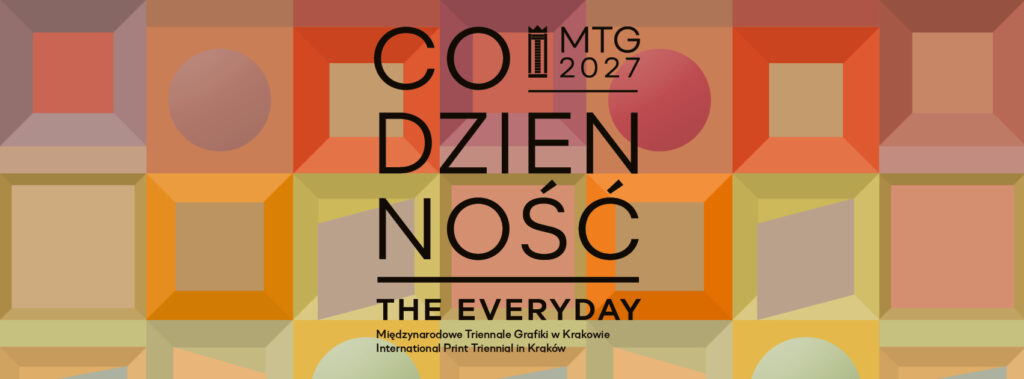
It is with great pleasure that we announce a new edition of the International Print Triennial in Krakow — The Everyday.
THE EVERYDAY
THE EVERYDAY is the main theme of the International Print Triennial 2027 in Kraków. We hope that this seemingly straightforward and well-understood term will give participants plenty to ponder.
When we start to think about the everyday more deeply, it may strike us that what we had initially considered to be obvious and easy to clarify conceals layers of meaning, nuance, and motifs.
The subject of the everyday has been taken up before in contemporary art. Artists have joined the path forged by philosophers, sociologists and psychologists who, in the latter half of the last century, intensively explored the concept of the everyday. Here we can recall thinkers such as Henri Lefebvre, Michel de Certeau, Erving Goffman, and Maurice Reuchlin. During the 1990s, the ‘turn towards the everyday’ was often mentioned in analysis of new art, spanning Tracey Emin’s creations, Sophie Calle’s photographs, Gabriel Orozco’s works, and Annette Messager’s installations. An important event was the 11th Biennale in Sydney, held in 1998. Curator Jonathan Watkins chose ‘Every Day’ as the main theme, encouraging artists to explore the simplicity and authenticity of quotidian life. Ten years later, in 2008, a collection of essays edited by Stephen Johnstone was published under the title The Everyday. This volume takes a wide-ranging look at how artists have tried to answer the question of ‘what happens when nothing happens’. Meanwhile, in Polish art, we can point to Julita Wójcik’s iconic 2001 performance in Warsaw’s Zachęta gallery, in which the artist carried out the prosaic task of peeling potatoes. This ‘housewife aesthetic’ was taken up by other women artists, and their works resonated with the thinking of Jolanta Brach-Czaina, who stressed in her ‘philosophy of the everyday’ that ‘we experience the fact of our existence as something ineffably important, and so we are completely bewildered whenever it strikes us that life is consumed by trifles’. Brach-Czaina elevated the daily domestic round to the rank of a subject worthy of philosophical inquiry, and the worn-out dishcloth became an expressive element in these considerations.
Why are we returning to the subject of the everyday for the latest Print Triennial?
The first quarter of the 21st century has already elapsed – a time of civilisational changes chiefly conjured by the rapid development of digitisation, encompassing the intensive growth of artificial intelligence. We have also witnessed ongoing global problems such as the climate crisis and the catastrophic state of the environment on many levels, alongside the Covid pandemic and huge waves of migration caused by the lack of a stable, peaceful geopolitical situation in the world. All this has significantly reformulated our everyday lives.
When Henri Lefebvre wrote about ‘the colonisation’ of our everyday existence by the predominant ‘system’, which forced us to carry out ‘controlled consumption’, he was thinking of the structures of modern capitalism controlling not only our work, but also the private sphere, which has become a ‘a commodity’. He could not have imagined that almost sixty years later, we would be facing the problem of the ‘colonisation’ of our time, autonomy and independence by controlling social media platforms, mobile internet and smartphones. Are we still able – as Lefebvre’s opponent Michel de Certeau saw it – to evade this appropriation and thereby form the essential pattern of our day-to-day lives? This question was posed by the Oscar-winning film Nomadland (2020), which explored the possibility of regaining an everyday existence that is completely stripped of consumerism. When the main character of the film loses her job and home, she begins a wandering life in a small van, finding meaning and control over her life in prosaic tasks, respect for nature and sharing moments with other nomads.
So how do we treat the everyday now? It is just a tiresome and boring routine? Do we appreciate the particular daily rituals which endow our life with a calm, secure rhythm, balance and even happiness? What, at all, does the everyday actually mean to each of us? What happens when that everyday rhythm is taken away by unexpected moments, events, illnesses, cataclysms, war. Are we able to survive without a daily dose of the internet, Facebook, Instagram, TikTok, or WhatsApp? Has our everyday life already become simply a mix of real and virtual space that have blended together? What can the everyday mean for an artist? How can it serve as a point of reference for artistic narratives in today’s world? How does the everyday resonate in the sphere of graphic art?
We hope that this theme inspires the Triennial’s participants to think deeply, leading to interesting artistic interpretations and activity. Come and join us on the journey!
Monika Rydiger
Curator of the International Print Triennial MTG 2027 in Kraków